



Table of Contents
ToggleAssisted Living Facilities (ALF) in the United States are undergoing a significant transformation. Once focused primarily on lifestyle support, these communities are increasingly expected to manage residents with higher clinical needs. This shift is driven by aging populations, hospital discharge pressures, and evolving reimbursement models under CMS.
In this new environment, Vital Sign Monitoring in Assisted Living is becoming a foundational capability. By leveraging EWS frameworks, NCBP measurements, and continuous tracking, assisted living providers can improve care quality, support early detection of health issues, and align more closely with Skilled Nursing Levels of Care.
The Evolving Role of Assisted Living Facilities
Assisted living is no longer limited to basic daily support. Today’s residents often present with:
- Multiple chronic conditions
- Complex medication regimens
- Increased risk of clinical deterioration
This evolution has blurred the line between assisted living and skilled nursing. Families and healthcare systems now expect ALF to deliver higher levels of clinical oversight without compromising resident independence.
As a result, providers are adopting monitoring technologies to support safer, more coordinated care.
Why Vital Sign Monitoring in Assisted Living Is Becoming Essential
The importance of Vital Sign Monitoring in Assisted Living is directly tied to the need for proactive care.
Key drivers include:
Early detection of health issues: Continuous observation of vitals can reveal subtle changes before symptoms become severe
Reduced Hospital Readmissions: Monitoring supports timely clinical interventions, which may help prevent avoidable hospital transfers
Regulatory alignment: CMS and value-based care models emphasize outcomes, making monitoring a strategic necessity
Vital sign monitoring enables caregivers to move from reactive care to a more structured, observation-driven approach.
Bridging Assisted Living and Skilled Nursing Levels of Care
The transition between assisted living and skilled nursing is often marked by gaps in clinical oversight. Monitoring solutions help bridge this gap by introducing elements of Leveraging Solutions for Skilled Nursing Levels of Care into ALF.
This includes:
- Continuous physiological observation
- Integration with clinical workflows
- Support for EWS-based assessments
By adopting these capabilities, assisted living communities can deliver a higher standard of care while maintaining their core focus on resident comfort and independence.
10 Proven Ways to Reduce Hospital Readmissions in Assisted Living
Reducing hospital readmissions is a top priority for ALF. Below are 10 proven ways to reduce hospital readmissions using structured monitoring approaches.
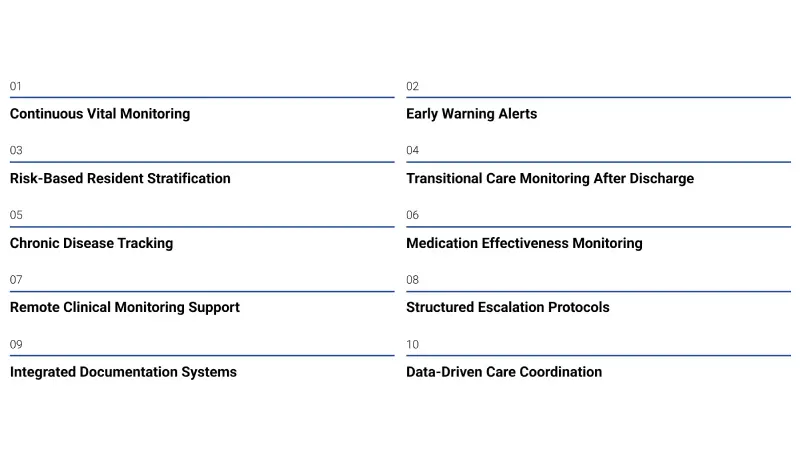
Continuous Vital Monitoring
Using continuous tracking, caregivers can observe trends in vital signs rather than relying on periodic checks.
Early Warning Alerts
EWS frameworks help identify patterns that may indicate deterioration, supporting timely clinical review.
Risk-Based Resident Stratification
Residents can be categorized based on risk levels, allowing staff to prioritize monitoring and care interventions.
Transitional Care Monitoring After Discharge
Post-discharge periods are high-risk. Monitoring during this phase supports safer recovery and continuity of care.
Chronic Disease Tracking
Ongoing observation of conditions such as CHF, COPD, and hypertension supports long-term stability.
Medication Effectiveness Monitoring
Vital trends can provide insights into how residents are responding to medications.
Remote Clinical Monitoring Support
Clinical monitoring services extend the reach of on-site staff, enabling centralized oversight.
Structured Escalation Protocols
Defined care pathways ensure that concerning trends are addressed consistently and appropriately.
Integrated Documentation Systems
Integration with EHR systems reduces documentation burden and improves data continuity.
Data-Driven Care Coordination
Shared data supports collaboration between caregivers, physicians, and specialists.
How Transitional Care Can Reduce Hospital Readmissions
Transitional care can reduce hospital readmissions by ensuring continuity between hospital discharge and assisted living care.
Key elements include:
- Monitoring during the first 7-14 days post-discharge
- Coordination between hospital and ALF care teams
- Structured follow-up protocols
This phase is critical, as many readmissions occur due to gaps in monitoring and communication.
Impact on Hospital Readmissions and Quality Metrics
Monitoring solutions directly influence performance metrics tracked by CMS and healthcare systems.
Key Outcomes:
- Reduced Hospital Readmissions
- Improved care transition outcomes
- Enhanced resident safety and satisfaction
Facilities that implement structured monitoring strategies are better positioned to meet quality benchmarks and improve their reputation among referral partners.
Operational Benefits for Assisted Living Communities
Beyond clinical outcomes, monitoring solutions offer significant operational advantages.
Key Benefits:
- Reduced manual vital checks
- Improved staff efficiency
- Better prioritization of care activities
- Enhanced documentation accuracy
These efficiencies are particularly valuable in an environment where staffing shortages remain a persistent challenge.
Choosing the Right Vital Sign Monitoring Solution
Selecting the right solution requires a careful evaluation of both clinical and operational needs.
Key Considerations:
- Compatibility with existing EHR systems
- Ease of use for caregivers
- Support for EWS frameworks
- Scalability across multiple facilities
- Compliance with HIPAA standards
Providers should focus on solutions that integrate seamlessly into workflows while supporting long-term care objectives.
The Future of Assisted Living: Proactive, Data-Driven Care
The future of assisted living lies in proactive, data-informed care models. As resident acuity increases, the ability to monitor and respond to health changes will define the next generation of care delivery.
Emerging trends include:
- Wider adoption of monitoring technologies
- Greater alignment with skilled nursing practices
- Increased focus on RPM improve patient outcomes and value-based care
By leveraging monitoring solutions, assisted living communities can evolve into clinically capable environments without losing their resident-centered ethos.
FAQs
A vital signs monitor is used to track parameters such as heart rate, respiratory rate, blood pressure, oxygen saturation, and temperature.
Common vital signs include heart rate, blood pressure, oxygen saturation, respiratory rate, and temperature.
Readings should be evaluated in the context of patient history, baseline values, and observed trends.
The five vital signs are heart rate, respiratory rate, blood pressure, temperature, and oxygen saturation.