


Table of Contents
ToggleHealthcare in the United States is undergoing a fundamental shift, from volume-based care to value-based care, where patient outcomes define success. As providers face increasing pressure from CMS quality programs, staffing shortages, and rising chronic disease prevalence, Remote Patient Monitoring (RPM) has emerged as a critical tool for improving care delivery.
By enabling continuous tracking of patient health data outside traditional care settings, RPM supports earlier clinical interventions, improved care coordination, and better long-term outcomes. For hospitals and Skilled Nursing Facilities (SNF), this shift is not optional, it is strategic.
Why Patient Outcomes Are the Core Focus in Modern Healthcare
Shift from Reactive to Proactive Care
Historically, healthcare has been reactive, intervening only after symptoms worsen. Today, providers are moving toward proactive care models that focus on early identification of risk and timely intervention.
RPM enables this transition by offering visibility into patient health trends between clinical visits, allowing care teams to act before conditions escalate.
Growing Need in Skilled Nursing Facilities and Long-Term Care
SNF and long-term care facilities manage high-risk populations with complex comorbidities. Frequent hospital readmissions, regulatory scrutiny, and limited staffing resources make outcome improvement a top priority.
In these settings, RPM plays a crucial role in stabilizing residents, supporting transitional care, and aligning with value-based reimbursement frameworks.
What Is a Continuous Patient Monitoring System?
Definition of Continuous Monitoring
A continuous patient monitoring system refers to technologies that track vital signs and physiological parameters consistently over time, rather than at intermittent intervals.
This approach provides a more comprehensive view of patient health, especially in detecting subtle changes that may indicate deterioration.
How Continuous Patient Monitoring Systems Work
A typical system includes:
- Sensors or devices capturing vital signs (heart rate, respiratory rate, oxygen saturation, etc.)
- Secure data transmission aligned with HIPAA requirements
- Clinical dashboards for care teams
- Structured frameworks such as EWS for interpreting trends
This combination allows clinicians to monitor patients beyond episodic assessments and respond more effectively to evolving conditions.
How Remote Patient Monitoring Improves Patient Outcomes
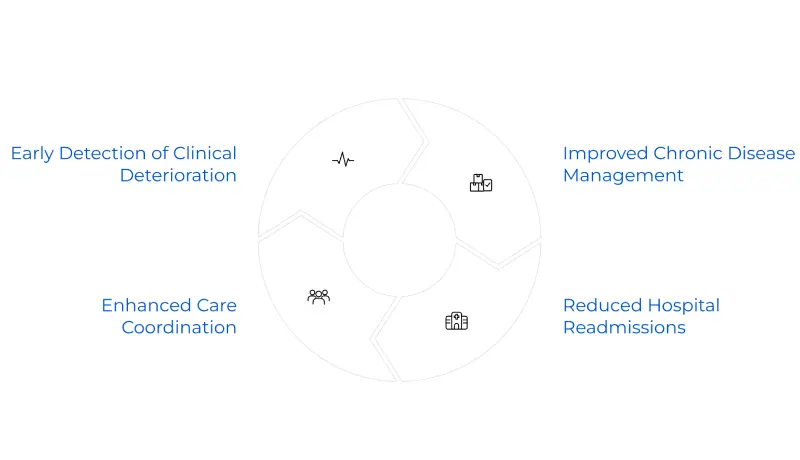
1. Early Detection of Clinical Deterioration
RPM supports identification of subtle physiological changes that may indicate worsening conditions. Using structured scoring frameworks like EWS, clinicians can assess risk and intervene sooner.
2. Improved Chronic Disease Management
Conditions such as heart failure, COPD, and hypertension require consistent monitoring. RPM helps maintain stability by tracking trends and supporting timely adjustments in care plans.
3. Reduced Hospital Readmissions
By identifying risks earlier and supporting better transitional care, RPM contributes to reduced avoidable readmissions, a key performance metric under CMS programs.
4. Enhanced Care Coordination
RPM enables seamless communication between providers across care settings. This ensures continuity of care, especially during transitions from hospital to SNF or home.
These improvements collectively contribute to measurable remote patient monitoring outcomes, including better clinical stability and improved quality metrics.
Exploring Benefits of Continuous Monitoring in Healthcare
When evaluating the exploring benefits of continuous monitoring in healthcare data security and clinical performance, several advantages emerge:
- Improved visibility: Continuous tracking offers deeper insights into patient health patterns
- Better clinical prioritization: High-risk patients can be identified more effectively
- Reduced manual workload: Nurses spend less time on routine checks and documentation
- Enhanced patient safety: Early intervention reduces adverse events
These remote patient monitoring benefits are particularly impactful in high-acuity environments like SNF.
Key Remote Patient Monitoring Applications
RPM is being used across a wide range of clinical scenarios:
- Chronic disease management (CHF, COPD, diabetes)
Post-acute recovery monitoring - Cardiovascular and respiratory tracking
- Long-term care resident monitoring
- Transitional care management
These remote patient monitoring applications highlight its versatility across care settings.
What Role Does AI Play in Remote Patient Monitoring?
While RPM systems rely on data collection and clinical frameworks, advanced analytics are increasingly used to interpret trends and prioritize care.
These capabilities support:
- Pattern recognition in patient data
- Risk stratification for clinical decision-making
- Enhanced efficiency in monitoring large patient populations
However, it is important to ensure that such technologies are used responsibly, with transparency and adherence to regulatory guidelines.
Data Security in Remote Patient Monitoring Systems
Importance of Data Security in Healthcare
Patient data is highly sensitive, making security a critical component of RPM systems. Compliance with HIPAA regulations is essential to protect patient privacy and maintain trust.
Key Security Measures
Effective RPM platforms incorporate:
- Encrypted data transmission
- Role-based access controls
- Secure cloud infrastructure
- Regular compliance audits
Strong data security ensures that RPM systems remain reliable and compliant within the US healthcare ecosystem.
Choosing the Right Remote Patient Monitoring Company
Selecting the right remote patient monitoring company is essential for achieving desired outcomes.
Key Evaluation Criteria:
- Clinical accuracy and reliability
- Integration with EHR systems
- Compliance with HIPAA and CMS guidelines
- Scalability across care settings
- Support for EWS and structured monitoring frameworks
Organizations should prioritize vendors that align with their clinical and operational goals.
Challenges and Considerations in RPM Implementation
Despite its benefits, RPM adoption comes with challenges:
- Workflow integration complexities
- Training requirements for staff
- Data interpretation without structured frameworks
- Initial investment costs
Addressing these considerations requires careful planning, stakeholder engagement, and ongoing evaluation.
The Future of Remote Patient Monitoring and Patient Outcomes
The future of RPM lies in its ability to support longitudinal care models, where patients are monitored across the entire care continuum.
Key trends include:
- Expansion into primary care and home-based care
- Greater integration with EHR systems in healthcare
- Increased focus on outcome-based reimbursement models
As healthcare continues to evolve, RPM will play a central role in improving patient outcomes while addressing workforce and operational challenges.
FAQs
Patient outcomes are central to value-based care, influencing reimbursement, quality ratings, and overall healthcare performance.
RPM enables early detection of deterioration, better chronic disease management, and improved care coordination.
Continuous monitoring improves visibility, supports proactive care, and enhances patient safety.
When designed with HIPAA-compliant frameworks, RPM systems offer strong data protection through encryption and access controls.
RPM is used for chronic disease management, post-acute care, and long-term care monitoring.