




Table of Contents
ToggleIn the evolving U.S. healthcare landscape, early detection of patient deterioration has become a critical priority, especially in Skilled Nursing Facilities (SNF), where residents often present with complex, chronic conditions. With increasing pressure from CMS to improve quality outcomes and reduce avoidable hospitalizations, providers are turning to structured clinical tools to enhance patient safety.
One such tool is the modified early warning score (MEWS), a standardized approach designed to identify subtle changes in patient condition before they escalate. When integrated with EWS frameworks, NCBP measurements, and continuous tracking, MEWS supports proactive care delivery aligned with value-based care models.
What Is the Modified Early Warning Score (MEWS)?
MEWS Modified Early Warning System Explained
The mews modified early warning system is a clinical scoring method used to assess patient health based on vital signs. It assigns numerical values to physiological parameters, enabling caregivers to quickly evaluate risk levels.
The modified early warning score simplifies complex clinical data into an actionable score, helping care teams prioritize attention and intervention.
Why MEWS Is Important in Healthcare
MEWS is widely used because it:
- Standardizes patient assessment
- Reduces reliance on subjective judgment
- Enables early identification of deterioration
For SNF, where staffing levels may be limited, the mews early warning system provides a structured approach to monitoring residents effectively.
How the MEWS Early Warning System Works
The MEWS Scoring Methodology
The MEWS system assigns scores based on deviations from normal vital ranges. Each parameter is evaluated independently and then combined into a total score.
Higher scores indicate increased risk, prompting clinical escalation.
Key Parameters in a MEWS Scoring Chart
A typical mews scoring chart includes:
- Heart rate
- Respiratory rate
- Blood pressure (NCBP)
- Temperature
- Level of consciousness
These parameters form the foundation of the early warning score tool, allowing consistent evaluation across care settings.
Understanding the MEWS Scoring Chart
MEWS Score Interpretation
The total score helps classify patient risk:
- Low Score: Stable condition
- Moderate Score: Requires closer observation
- High Score: Indicates potential deterioration
This structured interpretation supports timely clinical decision-making.
Clinical Actions Based on MEWS Scores
Depending on the score, care teams may:
- Increase monitoring frequency
- Escalate to senior clinicians
- Initiate further diagnostic evaluation
In SNF, this structured approach helps ensure that early warning signs are not overlooked.
Role of MEWS in Skilled Nursing Facility (SNF) Care
Monitoring High-Risk Residents
SNF cares for residents with multiple comorbidities, making them particularly vulnerable to clinical deterioration. MEWS enables systematic monitoring of these high-risk individuals.
Early Detection of Deterioration
By tracking vital sign changes over time, MEWS supports early identification of deterioration patterns, helping to reduce avoidable readmissions.
Supporting Limited Clinical Staff
With ongoing workforce shortages, SNF requires tools that enhance efficiency. The mews early warning system allows staff to prioritize care based on risk, improving resource utilization.
Limitations of Traditional MEWS Systems in SNF
Intermittent Monitoring Challenges
Traditional MEWS relies on periodic vital checks, which may miss changes occurring between assessments.
Manual Scoring Errors
Manual calculation of scores can introduce inconsistencies and errors, especially in high-pressure environments.
Variability in Elderly Populations
Elderly residents often have atypical baseline values, making interpretation more complex.
MEWS as an Early Warning Score Tool in Modern Care
Integration with Monitoring Systems
Modern implementations integrate MEWS with monitoring systems that capture vital data continuously. This enhances accuracy and reduces manual workload.
Enhancing MEWS with Continuous Monitoring
Combining MEWS with continuous tracking allows providers to:
- Identify trends rather than isolated readings
- Improve risk stratification
- Support proactive care interventions
This approach aligns with EWS frameworks and strengthens clinical oversight.
MEWS vs Advanced Early Warning Systems
While MEWS is a foundational tool, advanced EWS frameworks build upon it by incorporating additional data inputs and trend analysis.
Key Differences:
- MEWS: Static scoring based on periodic measurements
- EWS frameworks: Dynamic evaluation using continuous data
In SNF, combining MEWS with broader monitoring strategies offers a more comprehensive approach to patient safety.
Best Practices for Implementing MEWS in SNF
Successful implementation requires:
- Staff training on scoring and interpretation
- Standardized protocols for escalation
- Integration with existing workflows
- Use of monitoring systems to support data collection
Additionally, aligning MEWS processes with CMS documentation requirements ensures compliance and supports reimbursement models.
The Future of Early Warning Systems in Skilled Nursing Facilities
As healthcare continues to evolve, early warning systems are becoming more integrated into care delivery.
Future trends include:
- Greater use of continuous monitoring technologies
- Improved integration with EHR systems
- Enhanced care coordination across settings
For SNF, adopting these advancements will be critical to improving outcomes and maintaining competitiveness in a value-based environment.
FAQs
It is a clinical tool that uses vital signs to calculate a score indicating patient risk.
Scores are assigned to vital sign parameters and summed to produce a total risk score.
Heart rate, respiratory rate, blood pressure, temperature, and consciousness level.
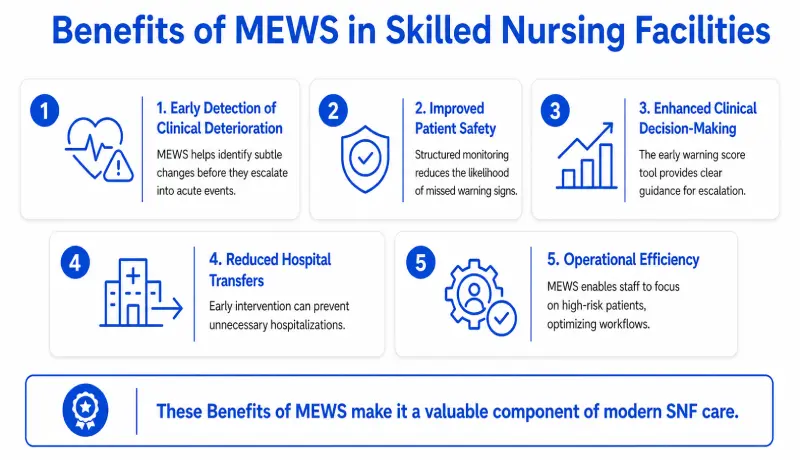
Benefits include early detection of deterioration, improved safety, and reduced hospital transfers.
Limitations include reliance on intermittent monitoring and potential for manual errors.