




Table of Contents
ToggleSkilled Nursing Facilities (SNF) in the United States are facing a new reality, residents are sicker, stays are shorter, and expectations are higher. As healthcare shifts toward value-based care, SNF must deliver hospital-like oversight while operating within constrained staffing models.
In this context, vital signs monitoring is no longer a routine task, it is a strategic capability. By leveraging skilled nursing vitals monitoring, EWS frameworks, NCBP measurements, and continuous tracking, facilities can improve patient visibility, enhance care delivery, and align with CMS-driven outcomes.
The Rising Clinical Complexity in Skilled Nursing Facilities
SNF today are managing patients with:
- Multiple comorbidities such as CHF, COPD, and diabetes
- Post-acute recovery needs following hospital discharge
- Increased risk of sudden clinical deterioration
At the same time, staffing shortages and documentation burden continue to challenge care delivery.
This growing complexity requires a shift from periodic observation to continuous, structured monitoring supported by advanced patient vitals monitor systems.
Why Traditional Vital Signs Monitoring Is No Longer Enough
Traditional monitoring relies on intermittent checks, typically every few hours. While effective in stable conditions, this approach has limitations:
- Missed early signs of deterioration between checks
- High dependence on staff availability
- Delayed clinical response
In high-acuity SNF environments, these gaps can contribute to avoidable hospital transfers and inconsistent care outcomes.
Modern healthcare demands a more continuous and integrated approach to vital signs monitoring.
What Is Modern Skilled Nursing Vitals Monitoring?
Skilled nursing vitals monitoring refers to a structured approach that combines advanced vital signs equipment, data integration, and clinical frameworks.
Core Components:
- Continuous tracking of vital parameters such as HR, RR, SpO₂, and temperature
- NCBP measurements for blood pressure monitoring
- Integration with clinical workflows and documentation systems
Unlike traditional models, modern monitoring focuses on trends over time, enabling clinicians to better understand patient trajectories.
The Role of Early Warning Systems (EWS) in SNF
Early Warning Systems (EWS) provide a structured method for interpreting vital signs.
EWS frameworks:
- Combine multiple parameters into a composite score
- Highlight patterns that may indicate clinical deterioration
- Support clinicians in prioritizing patient care
In SNF, EWS serves as a decision-support layer that enhances clinical judgment without replacing it.
Contactless Vital Sign Monitoring Technology: The Next Evolution
The emergence of contactless vital sign monitoring technology represents a significant advancement in patient care.
This approach enables:
- Continuous tracking without requiring physical interaction
- Reduced disruption to patient rest and comfort
- Consistent data collection across extended periods
For SNF, contactless monitoring aligns well with infection control practices, patient comfort, and operational efficiency.
10 Ways Vital Sign Monitoring Transforms Skilled Nursing Facilities
Early Detection of Clinical Deterioration
Continuous observation enables earlier identification of subtle physiological changes.
Reduced Avoidable Acute Transfers
Better visibility into patient status supports timely interventions, potentially reducing hospitalizations.
Improved Chronic Disease Stability
Ongoing monitoring helps manage long-term conditions more effectively.
Reduced Documentation Burden
Integrated systems streamline data capture and reduce manual entry.
Smarter Staff Prioritization
Care teams can focus attention on residents who need it most.
Lower Notification Fatigue
Trend-based monitoring reduces unnecessary notifications and improves clinical focus.
Improved Transitional Care Oversight
Monitoring during post-discharge periods enhances continuity of care.
Better Quality Metrics
Facilities can improve performance on CMS-linked measures such as readmissions.
Enhanced Family Confidence
Families gain reassurance knowing their loved ones are being closely monitored.
Measurable ROI
Operational efficiencies and improved outcomes contribute to financial returns.
Choosing the Right Vital Signs Equipment for Your SNF
Selecting the appropriate vital signs equipment is critical for successful implementation.
Key Criteria:
- Accuracy and consistency of measurements
- Ease of use for nursing staff
- Integration with EHR systems
- Support for EWS frameworks
- Compliance with HIPAA and regulatory standards
Facilities should prioritize solutions that align with both clinical goals and operational realities.
Implementation Strategy for Skilled Nursing Vitals Monitoring
A structured implementation approach ensures successful adoption.
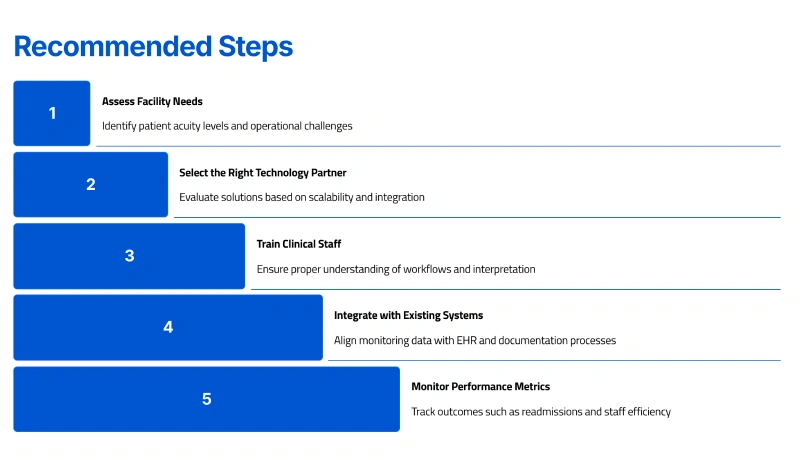
Phased implementation can help facilities scale gradually while maintaining care quality.
Financial and Clinical ROI of Vital Sign Monitoring
Investing in patient vitals monitor systems delivers both clinical and financial benefits.
Clinical ROI:
- Improved patient outcomes
- Enhanced chronic disease management
- Better care continuity
Financial ROI:
- Reduced readmission penalties
- Improved reimbursement alignment
- Lower operational costs through efficiency gains
For SNF operating under value-based care models, these outcomes are critical for long-term sustainability.
The Future of Skilled Nursing: Proactive, Predictive, and Continuous
The future of skilled nursing is defined by proactive care models supported by data-driven insights.
Key trends include:
- Expansion of contactless vital sign monitoring technology
- Greater integration with EHR systems
- Increased reliance on EWS frameworks
As care delivery evolves, SNF that adopt continuous monitoring strategies will be better positioned to meet clinical, operational, and financial demands.
FAQs
A vital sign monitor is used to track parameters such as heart rate, respiratory rate, blood pressure, oxygen saturation, and temperature.
Clinicians interpret readings based on standard ranges, patient history, and trends over time, often supported by EWS frameworks.
Types include bedside monitoring, contactless monitoring, and wearable-based systems, depending on clinical needs.
It typically measures ECG, heart rate, respiratory rate, blood pressure, oxygen saturation, temperature, and sometimes CO₂ levels.
The five vital signs are heart rate, respiratory rate, blood pressure, temperature, and oxygen saturation.