

Table of Contents
ToggleThe US healthcare system is under increasing pressure. Rising chronic disease prevalence, workforce shortages, and expanding value-based care models are reshaping how care is delivered. Hospitals, skilled nursing facilities (SNF), and outpatient providers must balance quality outcomes with operational sustainability.
Traditional episodic monitoring, capturing vitals only during scheduled visits, may miss gradual deterioration. This has accelerated demand for continuous tracking and technology-driven oversight.
At the center of this transformation is remote patient monitoring software. It serves as the operational backbone of modern digital healthcare by connecting clinicians, patients, and monitoring infrastructure into a structured, reimbursable framework aligned with CMS guidelines.
What Is Remote Patient Monitoring Software?
Remote patient monitoring software is a digital platform that collects, aggregates, and organizes patient health data from monitoring tools outside traditional acute-care settings.
Under CMS definitions, Remote Patient Monitoring (RPM) involves the collection and transmission of physiological data such as heart rate, respiratory rate, oxygen saturation, or blood pressure for evaluation by a healthcare professional.
RPM software enables:
- Data visualization through clinician dashboards
- Documentation for CPT codes 99453, 99454, 99457, and 99458
- Integration with EHR systems
- HIPAA-compliant data handling
It transforms data from remote patient monitoring devices into actionable clinical insights within a compliant structure.
Key Components of Remote Patient Monitoring Solutions
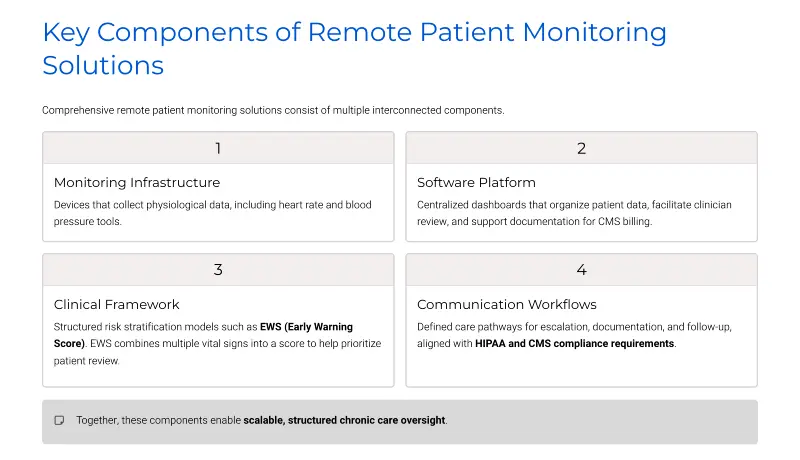
Comprehensive remote patient monitoring solutions consist of multiple interconnected components.
Monitoring Infrastructure
Devices that collect physiological data, including heart rate and blood pressure tools.
Software Platform
Centralized dashboards that organize patient data, facilitate clinician review, and support documentation for CMS billing.
Clinical Framework
Structured risk stratification models such as EWS (Early Warning Score). EWS combines multiple vital signs into a score to help prioritize patient review.
Communication Workflows
Defined care pathways for escalation, documentation, and follow-up, aligned with HIPAA and CMS compliance requirements.
Together, these components enable scalable, structured chronic care oversight.
Role of Remote Patient Monitoring Devices
Remote patient monitoring devices serve as the data collection layer of RPM programs.
Common examples include:
- Blood pressure cuffs
- Pulse oximeters
- Glucose monitors
- Cardiac rhythm monitors
These patient care devices capture vital parameters that are transmitted into RPM software platforms.
Advanced platforms may incorporate NCBP (Non-Cuff Blood Pressure) trend estimation, complementing traditional cuff-based readings. NCBP provides longitudinal blood pressure insights without replacing validated measurement tools.
When integrated properly, devices and software work together to provide Continuous tracking across care settings.
How RPM Software Enhances Patient Care
Early Identification of Deterioration
Continuous tracking enables clinicians to observe trends rather than isolated readings. Gradual changes in vital patterns may indicate worsening chronic conditions.
By incorporating EWS frameworks, RPM software helps prioritize patients who require closer evaluation.
Improved Chronic Disease Management
Conditions such as hypertension, diabetes, heart failure, and COPD benefit from longitudinal oversight.
RPM software supports:
- Structured medication review
- Ongoing patient engagement
- Risk stratification based on trend analysis
This aligns with CMS Chronic Care Management (CCM) and value-based care objectives.
Increased Patient Engagement
Patients feel reassured knowing their health data is being monitored between visits. This can strengthen adherence and trust, key components of chronic disease outcomes.
For elderly Medicare beneficiaries, simplified monitoring programs reduce unnecessary clinic visits while maintaining oversight.
How RPM Software Improves Clinical Efficiency
Workforce shortages across hospitals and SNF demand operational optimization.
Centralized Oversight
RPM dashboards allow clinicians to oversee large patient populations from a single interface.
Rather than performing repetitive manual checks, teams can focus attention on patients with changing risk profiles.
Reduced Acute Care Utilization
Early identification of risk trends may reduce emergency department visits and inpatient admissions.
This supports Hospital Value-Based Purchasing metrics and Medicare Advantage quality benchmarks.
CMS Reimbursement Alignment
RPM programs are reimbursable under defined CPT codes.
Structured documentation ensures compliance while improving care continuity.
Choosing the Right Remote Patient Monitoring Software Companies
Not all remote patient monitoring software companies provide the same level of infrastructure, compliance alignment, or scalability.
Healthcare organizations should evaluate vendors based on:
- HIPAA-compliant architecture
- CMS reimbursement support
- Integration with EHR systems
- Clinical decision-support frameworks such as EWS
- Device compatibility
- Scalability across hospital, SNF, and home settings
Dozee’s RPM platform, for example, integrates continuous tracking with structured risk scoring while maintaining regulatory alignment.
For providers seeking reliable remote patient monitoring solutions, choosing a vendor with demonstrated compliance and scalable infrastructure is essential.
Conclusion
The shift toward technology-enabled care is accelerating across the US healthcare system.
Remote patient monitoring software plays a central role in improving both patient outcomes and operational performance. By integrating data from remote patient monitoring devices, supporting EWS-based prioritization, and aligning with CMS reimbursement frameworks, RPM software strengthens chronic disease management.
For hospitals, SNF, and value-based care organizations, scalable RPM infrastructure is no longer optional, it is foundational to modern care delivery.
Dozee’s approach to structured continuous tracking and compliant oversight positions it among trusted remote patient monitoring software companies supporting the next generation of digital healthcare.
FAQs
An RPM program involves collecting physiologic data from patients outside traditional clinical settings for review by healthcare professionals under CMS guidelines.
Physiologic monitoring (e.g., heart rate), chronic disease monitoring (e.g., hypertension), and post-discharge monitoring.
RPM services include device setup, data transmission, clinical review, and care management billed under CMS CPT codes.
By centralizing patient data, prioritizing risk using EWS frameworks, and reducing manual monitoring burden.
It enables continuous tracking, early identification of deterioration, and improved chronic disease oversight.