

In 2026, healthcare leaders are no longer asking whether remote patient monitoring works. They are asking a more strategic question: What is the ROI of remote patient monitoring?
With staffing shortages, rising acuity, and reimbursement pressures under CMS value-based programs, the financial viability of digital health investments matters more than ever. Understanding the cost of remote patient monitoring, its operational benefits, and long-term financial returns is essential before partnering with RPM companies.
Why ROI Is the #1 Question for RPM Adoption in 2026
Hospital CFOs and SNF administrators are under pressure to balance quality outcomes with margin protection.
Reimbursement frameworks such as:
- Hospital Value-Based Purchasing (HVBP)
- Hospital Readmissions Reduction Program (HRRP)
- SNF Value-Based Purchasing
directly tie financial performance to clinical outcomes.
RPM benefits must translate into measurable financial impact. Adoption decisions now depend on structured ROI modeling rather than technology appeal.
What Is the True Cost of Remote Patient Monitoring?
The cost of remote patient monitoring extends beyond devices. It includes infrastructure, integration, and operational oversight.
Hardware Costs
Hardware includes:
- Contact-based monitors
- Contactless cardiopulmonary sensors
- Central dashboards
Pricing varies based on:
- Device sophistication
- FDA clearance
- Deployment scale
Some rpm vendors operate on per-bed hardware models, while others bundle devices within subscription packages.
Software & Platform Costs
Software includes:
- Monitoring dashboards
- EWS scoring engines
- Data storage infrastructure
- Compliance modules
Remote patient monitoring pricing typically includes monthly per-bed or per-patient fees.
Integration & Deployment Costs
Integration costs may involve:
- EHR interoperability
- Staff training
- Workflow redesign
- IT configuration
Hospitals with complex EMR environments may experience higher upfront deployment expenses.
Ongoing Operational Costs
Operational costs include:
- Clinical review oversight
- Technical support
- Data management
Some rpm companies provide managed services models to offset internal staffing needs.
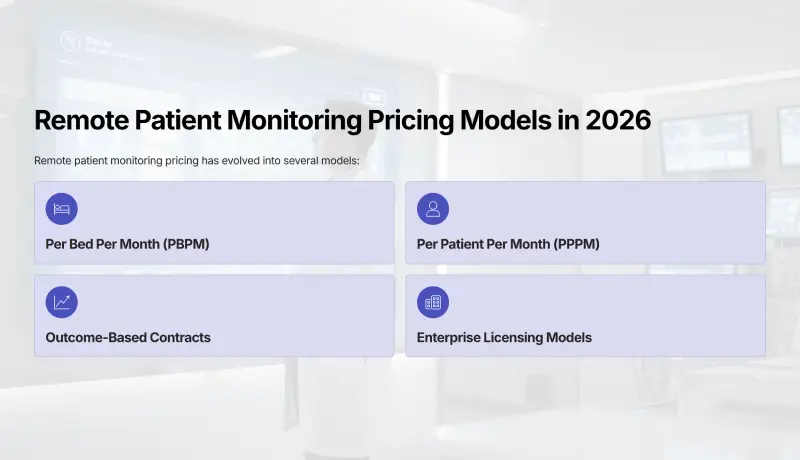
In Medicare outpatient RPM programs, CPT codes such as 99453, 99454, and 99457 provide reimbursement pathways. For inpatient and SNF settings, ROI is driven more by cost avoidance and quality metrics than direct billing.
Key Benefits That Drive RPM ROI
Reduction in ICU Transfers
Early detection of deterioration through Continuous tracking may reduce escalation events requiring ICU admission.
ICU days are among the most expensive inpatient costs.
Fewer Code Blue Events
Structured EWS prioritization can help identify physiologic instability before catastrophic decline.
Preventing one code event can significantly impact both cost and quality metrics.
Reduced Length of Stay (LOS)
Improved clinical visibility supports earlier intervention and potentially shorter recovery timelines.
Even a fractional reduction in LOS generates meaningful savings at scale.
Lower Readmission Rates
Under HRRP penalties, avoidable readmissions directly impact hospital revenue.
RPM benefits include strengthened post-discharge oversight, reducing costly return admissions.
Nursing Time Saved
Manual vital checks every 4–6 hours consume staff time.
Continuous tracking reduces repetitive tasks, allowing nurses to focus on higher-value care activities.
Time savings translate into improved productivity without increasing headcount.
Risk Mitigation & Compliance Protection
CMS survey readiness, litigation risk reduction, and improved documentation quality are significant financial drivers.
Structured monitoring strengthens audit defensibility and compliance posture.
Calculating the ROI of Remote Patient Monitoring
A simplified ROI model may include:
Savings from:
- Reduced ICU days
- Reduced LOS
- Fewer readmissions
- Lower agency staffing costs
- Avoided penalties
Minus:
- Hardware costs
- Platform subscription fees
- Implementation expenses
ROI = (Total Annual Savings – Total Annual RPM Costs) / Total Annual RPM Costs
Organizations frequently report positive ROI when reduction in escalation events offsets implementation investment.
Hidden Financial Benefits Often Overlooked
Beyond direct cost savings, several indirect advantages influence ROI:
- Staff retention improvement
- Reduced burnout-related turnover
- Improved patient satisfaction scores
- Stronger competitive positioning
- Enhanced payer negotiation leverage
These factors often compound financial impact over time.
Comparing RPM Companies: What Affects ROI the Most?
Not all rpm vendors generate equal ROI.
Critical differentiators include:
- Accuracy of physiologic measurement
- EWS sophistication
- Integration with existing workflows
- Scalability across care settings
- Security certifications (HIPAA, SOC 2)
Solutions that reduce manual workflow and provide meaningful prioritization typically yield stronger financial returns.
RPM in Hospitals vs Skilled Nursing Facilities (SNF)
Hospital ROI Drivers:
- ICU transfer reduction
- LOS optimization
- Readmission penalties
- Code event reduction
SNF ROI Drivers:
- Hospital transfer reduction
- Staffing efficiency
- Survey compliance
- Value-based purchasing incentives
SNFs may see ROI through avoided hospitalizations and improved Five-Star ratings.
Future Outlook: RPM ROI in 2026 and Beyond
In 2026, remote patient monitoring is transitioning from innovation to infrastructure.
As CMS reimbursement frameworks mature and value-based contracts expand, financial modeling will increasingly favor proactive monitoring.
Hospitals and SNFs that implement structured monitoring platforms today may position themselves competitively for future reimbursement models emphasizing risk mitigation and longitudinal oversight.
RPM ROI will likely strengthen as operational maturity increases and integration improves.
FAQs
Reduced ICU transfers, lower readmissions, decreased length of stay, and improved staffing efficiency.
Costs vary by vendor and model, typically structured per patient or per bed monthly.
Yes, several rpm companies offer scalable subscription models for smaller facilities.
It supports continuous oversight of vital signs and early identification of clinical deterioration.
RPM is expected to become a foundational component of value-based healthcare delivery.