


Chronic conditions such as heart failure, diabetes, COPD, and hypertension continue to drive the majority of healthcare utilization in the United States. According to the Centers for Medicare & Medicaid Services (CMS), most Medicare beneficiaries live with two or more chronic diseases, requiring coordinated and continuous medical oversight.
For healthcare organizations, especially skilled nursing facilities (SNF), managing chronic conditions effectively is essential for improving outcomes, maintaining compliance, and controlling operational costs. This is where Chronic Care Management (CCM) programs play a critical role.
When supported by structured monitoring and technology platforms, CCM enables providers to deliver proactive long-term care management while aligning with value-based reimbursement models.
What Is Chronic Care Management (CCM)?
Chronic Care Management (CCM) refers to a CMS-recognized care model designed to support patients living with multiple chronic conditions. CCM programs focus on coordinated care between clinical visits, helping healthcare providers monitor patient health status and adjust treatment plans over time.
A typical CCM program involves:
- Ongoing care coordination between providers
- Structured documentation of care plans
- Monitoring of physiological indicators such as heart rate, respiratory rate and NCBP trends
- Communication with patients and care teams regarding health status
Through ccm monitoring, providers gain better visibility into the long-term progression of chronic diseases and can intervene when risk patterns emerge.
Why CCM Is Critical in Skilled Nursing Facilities
Residents in SNF often have complex medical needs and multiple chronic diagnoses. Managing these conditions requires coordinated oversight that extends beyond episodic physician visits.
Common challenges in SNF include:
- High prevalence of cardiovascular and respiratory conditions
- Limited physician presence on-site
- Rising hospital readmission penalties
- Increasing regulatory scrutiny under CMS programs
CCM programs provide a structured framework that helps facilities monitor chronic conditions consistently while improving communication between clinicians, administrators, and care coordinators.
What Is a Chronic Care Management Platform?
A chronic care management platform is a digital infrastructure designed to support the operational and clinical components of CCM programs.
These platforms typically include:
- Patient monitoring dashboards
- Documentation and reporting tools
- Care plan management workflows
- Integration with electronic medical records
A well-designed ccm system allows healthcare teams to track patient status, review vital trends, and coordinate interventions across care teams.
When integrated with monitoring technologies and structured scoring frameworks such as EWS, these platforms can help clinicians identify deterioration patterns earlier.
How CCM Monitoring Works
Effective ccm monitoring relies on a combination of structured clinical workflows and digital monitoring tools.
Continuous Vital Tracking
Monitoring technologies capture physiological indicators such as heart rate, respiratory rate, and blood pressure trends. Continuous tracking provides clinicians with greater visibility into patient stability between clinical visits.
Risk Stratification
CCM platforms often incorporate risk assessment models that prioritize patients based on clinical status. These frameworks may include EWS-based scoring approaches that evaluate changes in physiological parameters.
Care Plan Updates
When clinical changes occur, providers update patient care plans to reflect evolving health needs. Care plans often include medication adjustments, therapy changes, and additional monitoring protocols.
Documentation and Reporting
CCM programs require structured documentation to meet CMS reimbursement and compliance requirements. Digital platforms simplify reporting and ensure care activities are recorded accurately.
CCM Tracking and Workflow Optimization in SNF
For long-term care providers, ccm tracking supports improved coordination across multidisciplinary teams.
CCM platforms allow staff to:
- Monitor chronic disease indicators across multiple residents
- Review patient trends without requiring constant bedside checks
- Coordinate care activities between nurses, physicians, and administrators
This workflow optimization is particularly valuable in facilities facing staffing shortages and increasing patient acuity.
By centralizing patient data and care documentation, CCM programs reduce administrative burden while improving clinical visibility.
CCM System vs Chronic Disease Management Platform - Are They Different?
The terms ccm system and chronic disease management platform are often used interchangeably, but there are subtle distinctions.
A ccm system is typically designed to support CMS Chronic Care Management reimbursement programs, including documentation, patient consent, and care coordination.
A chronic disease management platform, on the other hand, may focus more broadly on disease monitoring, patient engagement, and clinical analytics.
In practice, many healthcare organizations use integrated platforms that support both CCM workflows and broader chronic disease monitoring strategies.
CCM and RPM: How They Work Together
While CCM focuses on coordinated care management, Remote Patient Monitoring (RPM) provides objective physiological data that strengthens clinical oversight.
CCM (Chronic Care Management)
- Focuses on care coordination and patient engagement
- Supports structured care plans for chronic conditions
- Emphasizes communication between care teams
RPM (Remote Patient Monitoring)
- Captures physiological indicators through monitoring equipment
- Supports continuous tracking of vital parameters
- Helps clinicians identify trends in patient stability
Combined Impact
Together, ccm and rpm create a powerful framework for long-term care management. CCM organizes care coordination while RPM provides physiological insights that guide clinical decisions.
This combination supports proactive management of chronic diseases while helping facilities improve quality metrics and patient outcomes.
Benefits of CCM for Skilled Nursing Facilities
Clinical Benefits
- Improved monitoring of chronic disease progression
- Earlier identification of physiological instability
- Stronger care coordination across providers
Operational Benefits
- Better visibility into patient health trends
- Reduced administrative burden through centralized documentation
- Improved workflow efficiency for clinical staff
Financial Benefits
- Support for CMS reimbursement programs
- Potential reduction in avoidable hospital readmissions
- Stronger performance under value-based care models
These benefits make CCM programs a strategic priority for many healthcare organizations managing complex patient populations.
Barriers to Effective CCM Implementation
Despite the benefits, implementing CCM programs can present challenges.
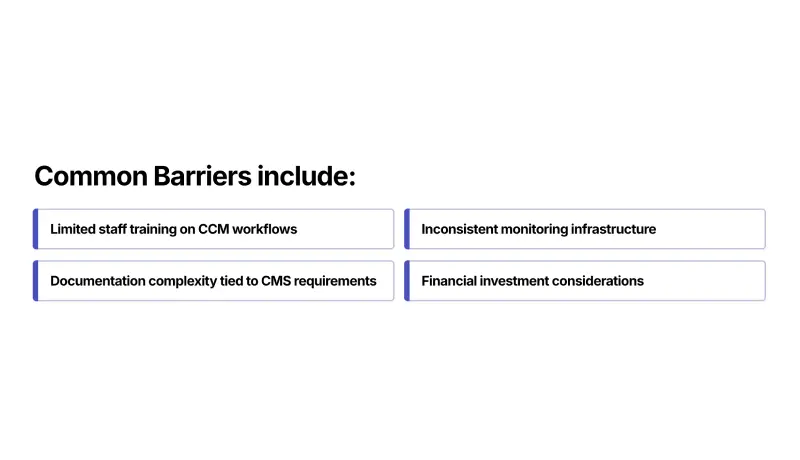
Facilities that address these challenges through leadership engagement, staff education, and technology integration are more likely to achieve successful CCM outcomes.
The Future of Chronic Care Management in Long-Term Care
As the US population continues to age, chronic disease prevalence is expected to rise significantly. Healthcare organizations must therefore adopt scalable care models capable of managing long-term conditions efficiently.
Future CCM strategies may include:
- Greater integration with remote patient monitoring programs
- Expanded use of digital monitoring technologies
- Stronger alignment with value-based reimbursement models
- Improved coordination between hospitals and long-term care facilities
For SNF, the ability to monitor and manage chronic diseases proactively will be essential for maintaining care quality, improving operational performance, and meeting regulatory expectations.
FAQs
CCM refers to Chronic Care Management, a CMS-recognized program designed to support coordinated care for patients with multiple chronic conditions.
CCM focuses on care coordination and management, while RPM focuses on monitoring physiological indicators through remote monitoring equipment.
A chronic care management platform is a digital system that supports patient monitoring, care plan documentation, and coordination between healthcare providers.
Clinics should evaluate integration with existing systems, compliance with healthcare regulations, monitoring capabilities, and ease of use.
Several healthcare technology providers like Dozee offer CCM platforms that align with CMS reimbursement programs.
Many monitoring platforms combine CCM workflows with RPM technologies to provide scalable solutions for healthcare organizations.
Digital platforms provide centralized access to patient data, care plans, and monitoring insights, enabling better coordination and oversight of chronic diseases.