




Table of Contents
ToggleAs healthcare systems in the United States continue shifting toward value-based care, rpm in healthcare has emerged as a critical tool for improving patient visibility beyond traditional clinical settings. For hospitals, physician groups, and Skilled Nursing Facilities (SNF), the ability to monitor patients continuously, without increasing staff burden, is becoming essential.
Patient remote monitoring enables clinicians to observe physiological parameters, track recovery, and identify potential risks earlier in the care journey. From chronic disease management to post-acute recovery, RPM is transforming how care is delivered, coordinated, and measured.
What Is RPM in Healthcare?
Remote Patient Monitoring (RPM) refers to the use of digital technologies to collect and analyze patient health data outside conventional clinical environments.
In practical terms, rpm patient monitoring involves:
- Tracking vital signs such as heart rate, respiratory rate, oxygen saturation, and temperature
- Using NCBP (non-contact blood pressure) measurements for cardiovascular monitoring
- Applying EWS frameworks to identify patterns that may require clinical attention
RPM supports remote clinical monitoring, allowing care teams to stay informed about patient status between in-person evaluations. This is particularly valuable in long-term care and chronic disease management, where patient conditions can evolve gradually.
How Patient Remote Monitoring Works
Modern remote patient care technology integrates multiple components to create a structured monitoring ecosystem.
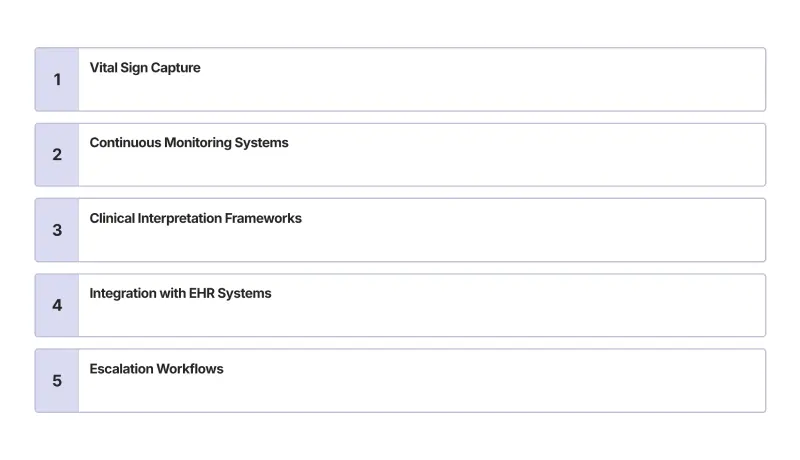
Key Elements:
Vital Sign Capture
Devices collect key physiologic parameters such as HR, RR, BP, SpO₂, and temperature. These measurements form the foundation of healthcare conditions monitoring.
Continuous Monitoring Systems
With continuous tracking, clinicians can observe trends over time rather than relying solely on periodic checks.
Clinical Interpretation Frameworks
EWS (Early Warning Systems) help contextualize vital signs by identifying patterns that may indicate deterioration.
Integration with EHR Systems
Data flows into electronic health records, ensuring continuity and supporting clinical documentation.
Escalation Workflows
Structured workflows guide clinicians on when to intervene, ensuring timely and appropriate responses.
This integrated approach enables patient remote monitoring to function as an extension of clinical care rather than a standalone tool.
Key Healthcare Conditions RPM Can Track and Manage
RPM is not limited to a single condition, it supports a wide range of clinical use cases across care settings.
Congestive Heart Failure (CHF)
CHF patients require close monitoring due to the risk of fluid overload and cardiac instability.
RPM supports:
- Tracking heart rate and respiratory patterns
- Observing gradual physiological changes
- Supporting early clinical intervention through EWS frameworks
Chronic Obstructive Pulmonary Disease (COPD)
COPD management benefits from continuous observation of respiratory parameters.
RPM enables:
- Monitoring respiratory rate and oxygen saturation
- Identifying early signs of exacerbation
- Supporting long-term disease stability
Hypertension
Hypertension is one of the most common chronic conditions in SNF.
With NCBP measurements, RPM helps:
- Track blood pressure trends over time
- Support medication management decisions
- Improve long-term cardiovascular outcomes
Diabetes (Indirect Monitoring)
While RPM does not directly measure glucose in all systems, it supports diabetes care indirectly.
- Monitoring vital signs linked to metabolic health
- Identifying patterns associated with complications
- Supporting care coordination
Post-Acute Recovery Monitoring
Post-discharge patients often require structured monitoring to prevent complications.
RPM supports:
- Tracking recovery trends
- Identifying deviations from expected recovery pathways
- Enhancing care transitions
This is where recovery monitoring solutions reviews often highlight RPM’s value in reducing readmissions.
Chronic Pain Management
Remote monitoring for chronic pain focuses on indirect indicators such as sleep patterns and physiological stress markers.
RPM can:
- Support pain management plans
- Provide insights into patient well-being
- Enhance clinician-patient communication
Sepsis Risk Detection
Sepsis risk increases in elderly and post-acute populations.
RPM contributes by:
- Monitoring vital sign variability
- Supporting early identification of concerning trends
- Enabling timely clinical evaluation
Sleep Apnea and Respiratory Instability
RPM can support monitoring of respiratory patterns during rest.
This helps clinicians:
- Identify irregular breathing patterns
- Assess sleep-related conditions
- Support treatment planning
Cardiac Arrhythmias
While specialized diagnostics are required for confirmation, RPM can provide early indicators of irregular heart rhythms.
- Monitoring heart rate variability
- Supporting clinical assessment
- Identifying potential concerns
General Deterioration in Elderly Residents
In SNF, gradual deterioration is often difficult to detect through periodic checks alone.
RPM supports:
- Continuous observation of physiological trends
- Early identification of subtle changes
- Improved overall patient monitoring
What RPM Cannot Replace
While RPM is a powerful tool, it is not a replacement for clinical expertise or in-person care.
RPM does not replace:
- Physical examinations
- Diagnostic imaging or laboratory testing
- Clinical judgment and decision-making
Instead, RPM acts as a complementary layer that enhances visibility and supports clinicians in delivering more informed care.
Benefits of Remote Clinical Monitoring Across Conditions
The value of remote clinical monitoring extends across multiple dimensions.
Key Benefits:
- Improved patient visibility: Continuous tracking enables better understanding of patient status
- Enhanced care coordination: Shared data supports collaboration between care teams
- Reduced hospitalizations: Early identification of trends may help prevent complications
- Better chronic disease management: Ongoing monitoring supports long-term stability
These benefits align closely with value-based care objectives and CMS quality measures.
Choosing the Right RPM Monitoring System
Selecting the right rpm monitoring system requires careful evaluation.
Key Considerations:
- Integration with EHR systems
- Ease of use for clinical staff
- Scalability across care settings
- Compliance with HIPAA data security standards
- Support for EWS-based clinical frameworks
Healthcare organizations should also review recovery monitoring solutions reviews to understand real-world performance and outcomes.
The Future of Healthcare Conditions Monitoring
The future of healthcare conditions monitoring lies in expanding the scope and depth of RPM.
Emerging trends include:
- Broader adoption in long-term care and home settings
- Enhanced integration with care pathways
- Greater focus on longitudinal patient management
As healthcare continues to evolve, RPM will play a central role in enabling more proactive, patient-centered care models.
FAQs
Monitoring tools typically include vital sign tracking, integration with EHR systems, and support for clinical decision-making frameworks like EWS.
Benefits include improved patient visibility, better care coordination, and support for chronic disease management.
RPM can support monitoring of conditions such as CHF, COPD, hypertension, post-acute recovery, and general deterioration in elderly patients.
RPM supports remote monitoring for chronic pain indirectly through physiological indicators and patient health trends.
RPM enhances care delivery by providing continuous tracking of patient health, supporting better clinical decisions.
Traditional monitoring relies on periodic checks, while RPM enables continuous observation of patient trends over time.