Table of Contents
ToggleThe U.S. healthcare system is steadily transitioning from episodic interventions to continuous, patient-centered care models. For Skilled Nursing Facilities (SNF), this shift is especially critical as residents often have multiple chronic conditions, complex medication regimens, and elevated risk of deterioration.
RPM-powered longitudinal care offers a structured approach to remote patient care, enabling clinicians to monitor patients beyond scheduled visits. By integrating EWS frameworks, NCBP measurements, and continuous tracking, providers can improve continuity, strengthen outcomes, and reduce avoidable readmissions.
Why Longitudinal Care Matters in Skilled Nursing Facilities
SNF operates at the intersection of post-acute recovery and long-term care. Residents frequently transition between hospitals, rehabilitation centers, and home settings, creating fragmentation in care delivery.
Key challenges include:
- Gaps in patient monitoring between clinical encounters
- Limited visibility into evolving health conditions
- Increasing CMS pressure to reduce readmissions and improve quality metrics
Longitudinal care addresses these gaps by ensuring that patient data, clinical insights, and care plans remain connected across the entire care journey.
What Is Longitudinal Care?
Longitudinal care refers to continuous, coordinated care delivered over time, rather than isolated interventions.
Key Elements:
- Continuity of care: Ongoing engagement with patients across care settings
- Data integration: Seamless flow of clinical information across providers
- Proactive management: Early identification of risk trends
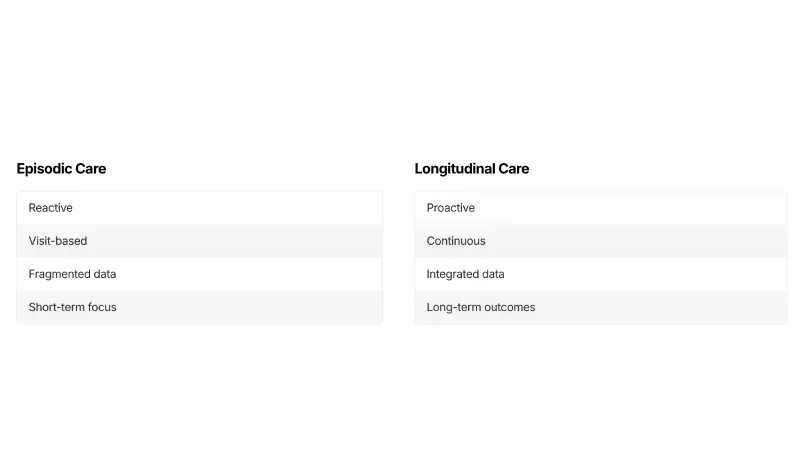
For chronic disease management such as CHF, COPD, and diabetes longitudinal care is essential for maintaining stability and preventing complications.
How RPM Enables Structured Remote Patient Care Pathways
RPM plays a foundational role in building remote patient care pathways that align with each stage of a patient’s journey.
Admission Phase
At admission, baseline vitals and patient history are established using remote patient care technology.
- Initial NCBP measurements
- Baseline physiological parameters
- Risk stratification
This creates a reference point for future clinical evaluation.
Stabilization Phase
During stabilization, clinicians use continuous tracking to observe patient response to treatment.
- Monitoring trends in vital signs
- Identifying deviations from baseline
- Supporting clinical decision-making
EWS frameworks can assist in highlighting patterns that may require closer clinical review.
Maintenance Phase
In the maintenance phase, RPM supports long-term condition management.
- Ongoing monitoring of chronic conditions
- Reinforcement of care plans
- Reduced dependency on frequent in-person checks
This structured pathway ensures continuity while optimizing resource utilization.
The Role of Clinical Monitoring Services in Longitudinal Oversight
Clinical monitoring services act as the operational backbone of longitudinal care models.
These services:
- Aggregate and interpret patient data
- Support clinicians in prioritizing care interventions
- Enable centralized oversight across multiple patients
In SNF, where staffing constraints are common, clinical monitoring services help extend the reach of care teams without increasing workload proportionally.
Improving Continuity Through Remote Patient Care Technology
Modern remote patient care platforms are designed to bridge gaps in care continuity.
Key Capabilities:
- Continuous physiological data collection through contactless methods
- Integration with clinical workflows
- Structured documentation support
While advanced systems may incorporate algorithmic trend analysis, their primary value lies in enabling clinicians to observe patient trajectories over time rather than relying solely on isolated readings.
The Role of EHR and Biometric Patient ID Technology
Integration with medical EHR systems biometric patient id technology support is critical for ensuring data accuracy and continuity.
Benefits:
- Accurate patient identification across care transitions
- Seamless data flow into electronic health records
- Reduced duplication of documentation
For SNF managing high patient volumes, this integration enhances operational efficiency and supports compliance with HIPAA data management standards.
RPM in Primary and Long-Term Care Coordination
The integration of remote patient monitoring primary care with long-term care settings creates a unified care ecosystem.
This coordination enables:
- Shared visibility between physicians and SNF staff
- Continuity across discharge and follow-up care
- Improved communication between care teams
Such alignment is particularly valuable under value-based care models, where outcomes depend on coordinated care delivery.
Reducing Readmission Rates Through Continuous Monitoring
Hospital readmissions remain a key performance metric for SNF under CMS guidelines.
RPM contributes to readmission reduction by:
- Supporting early identification of deterioration trends
- Enabling timely clinical intervention
- Enhancing care transition
Through continuous tracking, clinicians gain better visibility into patient status, which may help reduce avoidable hospitalizations.
Benefits of a Remote Patient Care Platform in SNF
Clinical Benefits
- Improved patient monitoring and risk visibility
- Enhanced chronic disease management
- Support for EWS-based clinical assessment
Operational Benefits
- Reduced manual vital checks
- Improved staff productivity
- Streamlined documentation processes
Financial Benefits
- Lower readmission-related penalties
- Improved reimbursement alignment under CMS programs
- Better resource allocation
Barriers to Longitudinal RPM Implementation
Despite its advantages, implementing RPM-powered longitudinal care presents challenges:
- Integration with existing systems
- Staff training and adoption
- Initial investment considerations
- Data management and compliance requirements
Addressing these barriers requires strategic planning, stakeholder alignment, and phased implementation.
The Future of Remote Patient Care Pathways
The future of remote patient care pathways lies in deeper integration, scalability, and standardization.
Emerging trends include:
- Expansion of RPM across care settings
- Increased use of EWS frameworks in SNF
- Stronger alignment with CMS reimbursement models
As healthcare continues to evolve, longitudinal care models will become central to improving outcomes and operational efficiency.
FAQs
Longitudinal care refers to continuous, coordinated care provided over time, focusing on long-term patient outcomes rather than isolated interventions.
RPM enables continuous tracking of patient vitals, allowing clinicians to monitor trends and maintain oversight between visits.
These are structured care journeys supported by monitoring technologies that guide patients from admission through long-term management.
RPM supports early identification of clinical changes, enabling timely interventions that may prevent hospital transfers.
Facilities should prioritize integration capabilities, clinical monitoring services, ease of use, and alignment with regulatory requirements.